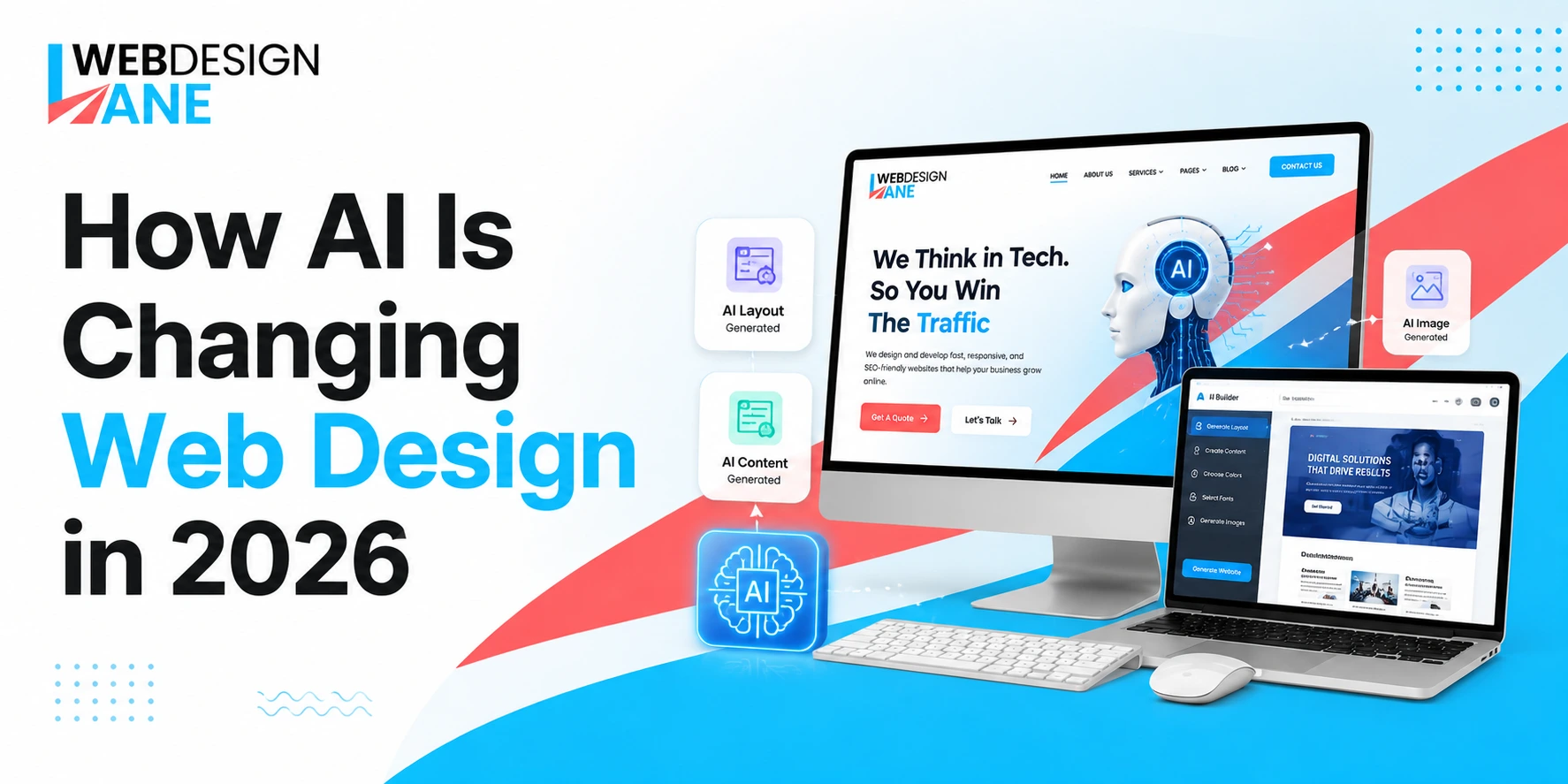

The AI website builder has evolved from a novelty experiment into the backbone of modern web design. In 2026, businesses are no longer asking whether artificial intelligence belongs in their design process. They are asking how deeply it should be integrated. From instant prototyping to real-time personalization, AI is rewriting the rules of how websites get built, optimized, and experienced by users.
We have watched this transformation unfold across every project we touch. What once required weeks of wireframing, manual coding, and iterative revisions now happens in a fraction of the time without sacrificing quality. This guide explores exactly how that shift is shaping the industry right now.
What This Guide Covers About AI in Web Design
This blog provides a detailed look at how AI is reshaping web design in 2026 and what it means for businesses investing in digital experiences.
- How AI website builders have matured beyond basic templates
- The rise of AI in web development workflows and what it means for teams
- Key AI website trends defining the 2026 landscape
- How AI design tools are accelerating creativity without replacing it
- Real-time personalization and dynamic user experiences
- Automated accessibility and SEO optimization
- The growing pushback against AI-generated sameness
- Practical guidance for businesses evaluating AI-powered web solutions
From Template Generators to Intelligent Design Partners
The first generation of AI website builders offered little more than drag-and-drop convenience layered over rigid templates. They were fast but shallow. In 2026, the technology has matured dramatically.
Modern AI website builder platforms now function as genuine design partners. They analyze your brand identity, content goals, target audience, and competitive landscape before generating complete site architectures, styled page layouts, and even placeholder copy that aligns with your messaging tone.
Platforms like Figma and Elementor have integrated conversational AI natively into their interfaces. A designer can now describe a desired layout in natural language and receive a fully structured prototype within minutes. This is not about replacing creative judgment. It is about eliminating the blank canvas problem and accelerating the path from concept to execution.
We have integrated these capabilities into our own workflows, and the impact has been significant. Projects that previously required two weeks of initial wireframing now move into design review within days. That time savings compounds across every phase of the project, giving clients faster launches without compromising on strategic depth.
The role of AI in web development has shifted from assistant to collaborator. And that distinction matters because it changes how teams allocate creative energy.
AI First Workflows Are Replacing Linear Processes
Traditional web design followed a predictable sequence. Discovery, wireframing, design, development, testing, launch. Each phase depended on the previous one finishing completely before the next could begin.
AI in web development has compressed and parallelized this process in ways that were impossible just two years ago.
Prompt to Prototype in Minutes
Designers now use AI to generate initial prototypes directly from written briefs. Instead of spending hours manually constructing wireframes, teams describe the desired experience and let AI produce a working starting point. The designer then refines, adjusts, and injects the strategic nuance that only human understanding can provide.
AI-Powered Code Generation
One of the most impactful AI website trends in 2026 is prompt-to-code functionality. AI coding assistants translate approved designs into clean, responsive code instantly. Complex interactive elements like feature-rich forms, dynamic filtering systems, and spatial UI components that previously required days of custom development can now be generated and refined in hours.
This does not eliminate the need for skilled developers. Instead, it elevates their role from writing repetitive boilerplate to solving genuinely complex problems. AI in web development handles the predictable patterns while humans focus on innovation and edge cases.
Continuous Iteration Without Bottlenecks
Because AI accelerates prototyping and code generation simultaneously, feedback loops tighten dramatically. Clients see working concepts faster. Revisions happen in real time rather than across multi-day cycles. The entire project rhythm changes from sequential handoffs to continuous collaboration.
We have restructured our internal processes around these AI-first workflows, and the results speak through faster delivery timelines, higher client satisfaction, and more room for creative exploration within every engagement.
Real-Time Personalization Is Making Static Sites Obsolete
One of the most transformative AI website trends in 2026 is the shift from static pages to dynamically personalized experiences. Static websites serve every visitor with the same content regardless of intent, behavior, or context. AI changes that fundamentally.
How Dynamic Personalization Works
Modern AI design tools monitor how individual visitors interact with a website in real time. Based on behavioral signals like scroll depth, click patterns, time on page, and referral source, the AI adjusts what the visitor sees next.
This means:
- Content blocks reorder themselves based on predicted user interest.
- Product recommendations adapt to browsing behavior within a single session.
- Navigation paths are simplified based on the visitor’s apparent intent.
- Headlines and calls to action shift to match the user’s stage in the buying journey.
Agentic Website Experiences
The concept of agentic design has emerged as a defining AI website trend in 2026. Websites now operate less like digital brochures and more like intelligent assistants. They anticipate friction points, surface relevant information proactively, and guide each visitor through a tailored journey without requiring manual segmentation by the marketing team.
For businesses investing in eCommerce, this level of personalization directly impacts revenue. Every visitor receives an experience optimized for their specific behavior patterns. When paired with professional eCommerce website development, these AI-driven personalization layers create shopping experiences that convert significantly better than traditional static storefronts.
The Data Foundation
Personalization only works when built on a reliable data infrastructure. AI design tools need clean analytics, proper tracking implementation, and well-structured content taxonomies to deliver meaningful adaptation. Businesses that invest in getting the data layer right see exponentially better personalization outcomes than those that bolt AI onto a messy foundation.
Automated Accessibility and SEO Optimization
Two areas where AI in web development has created the most universally positive impact are accessibility compliance and search engine optimization. Both have historically been labor-intensive, technically complex, and easy to neglect under deadline pressure. AI has changed that equation completely.
Proactive Accessibility Auditing
In 2026, AI design tools can scan entire domains and identify accessibility issues against WCAG standards automatically. This includes:
- Adjusting color contrast ratios to meet compliance thresholds.
- Generating descriptive alt text for images.
- Restructuring content hierarchy for screen reader compatibility.
- Identifying keyboard navigation gaps.
- Flagging interactive elements that lack proper ARIA labels.
What previously required a dedicated accessibility audit costing thousands of dollars and weeks of remediation now happens continuously in the background. This does not replace the value of human accessibility expertise for complex scenarios, but it ensures baseline compliance is maintained at all times rather than checked once and forgotten.
Continuous SEO Optimization
AI website builder platforms now include intelligent SEO engines that go far beyond basic meta tag suggestions. These systems continuously analyze:
- Keyword clustering and content gap opportunities
- Internal linking structure health
- Heading hierarchy and semantic markup
- Page speed performance factors
- Structured data implementation
The AI identifies optimization opportunities and, in many cases, implements fixes automatically. For businesses dependent on organic traffic, continuous optimization creates a growing advantage over competitors that still approach SEO as an occasional manual process.
Maintaining strong search visibility requires aligning technical SEO with evolving design standards. Insights around how website design trends influence SEO remain relevant as the foundation that current AI systems build upon and extend.
The Creative Rebellion Against AI Sameness
Every powerful tool creates a predictable problem when adopted widely. Early AI website builder adoption flooded the internet with a wave of visually similar websites. Clean, minimal, safe, and ultimately forgettable. In 2026, the most forward-thinking designers are actively pushing back against this homogenization.
Spatial and Interactive 3D Experiences
One of the most exciting AI website trends this year is the integration of spatial design elements powered by tools like Spline. Websites now feature layered motion, micro animations, and 3D objects that react dynamically to scrolling, mouse movements, and even device orientation.
These experiences feel immersive rather than flat. They create emotional engagement that static layouts simply cannot achieve. AI accelerates the technical implementation of these complex interactions while human designers direct the creative vision behind them.
Human Warmth Over Algorithmic Sterility
To stand out against the tide of AI-generated uniformity, designers are deliberately incorporating:
- Expressive and unconventional typography choices
- Organic shapes and hand-drawn elements
- Nostalgic textures and retro-inspired color palettes
- Intentional imperfections like glitch effects and grain overlays
- Photography and illustration that feels authentic rather than stock-generated
This is not anti-AI sentiment. It is a mature creative response that uses AI as an accelerator while ensuring the final product carries genuine personality. The most effective AI design tools in 2026 enable this balance by handling technical complexity while leaving creative direction firmly in human hands.
We embrace this philosophy in every project. AI makes us faster and more technically precise. But the brand voice, emotional resonance, and strategic storytelling that make a website truly effective will always require human insight and empathy.
Businesses that want a distinctive online presence benefit from working with professional website design services that know how to pair it with intelligent AI integration rather than surrendering creative control entirely to automation.
How AI Design Tools Are Reshaping Team Dynamics
The rise of AI design tools is not just changing what gets built. It is changing who builds it and how teams collaborate.
Designers Become Strategic Directors
When AI handles layout generation, responsive adaptation, and basic coding, designers spend less time on production tasks and more time on strategic decisions. They become experience architects who define how a brand communicates, how users feel, and how conversion paths flow. This is a significant elevation of the design role.
Developers Focus on Complex Problem Solving
Similarly, AI in web development frees developers from repetitive front-end tasks. Their energy shifts toward custom integrations, performance optimization, security architecture, and building the complex interactive systems that AI cannot yet handle independently.
Faster Client Collaboration
AI design tools enable real-time prototyping during client meetings. Instead of presenting static mockups and waiting days for feedback, teams can generate and modify concepts live. This accelerates decision-making, reduces revision cycles, and creates a more collaborative relationship between client and agency.
Cross-Functional Fluency
Because AI lowers the technical barrier for non-developers to generate functional prototypes, marketers, content strategists, and brand managers can participate more meaningfully in the design process. This cross-functional fluency leads to better outcomes because more perspectives inform the final product.
Businesses exploring how to build or scale their digital presence should understand how Shopify professionals create scalable stores using these same AI-enhanced workflows to deliver faster, smarter, and more conversion-focused results.
What Businesses Should Consider Before Adopting AI Website Builders
AI is powerful, but it is not a magic button. Businesses evaluating AI website builder platforms should consider several practical factors before committing.
|
Consideration |
What to Evaluate |
Why It Matters |
|
Brand Complexity |
How unique is your brand identity and messaging |
Generic AI output may dilute differentiation |
|
Content Volume |
How much existing content needs migration |
AI tools vary in content handling capabilities |
|
Integration Needs |
CRM, payment, analytics, third-party tools |
Not all AI builders support complex integrations |
|
Scalability Requirements |
Expected growth in traffic, products, or pages |
Platform limitations can create future bottlenecks |
|
Human Oversight |
Internal team capacity to review AI output |
AI requires strategic direction, not blind trust |
|
Budget Alignment |
Total cost including customization beyond AI defaults |
Cheap initial builds often require expensive fixes later |
The businesses that get the best results from AI design tools are those that pair automation with experienced human oversight. AI generates speed and scale. Human expertise delivers strategy, nuance, and brand integrity.
For businesses that need a strong brand foundation before layering AI capabilities on top, working with a focused branding agency ensures the strategic identity is defined clearly before any tool, AI or otherwise, begins executing.
Frequently Asked Questions
Building Smarter Without Losing What Makes You Human
AI has permanently changed web design, but it has not replaced the need for strategic thinking, creative vision, and genuine brand storytelling. The businesses winning in 2026 are not the ones blindly automating everything. They are the ones using AI website builder technology to move faster while investing the time saved into deeper creativity, sharper messaging, and more meaningful user experiences.
When you are ready to build a website that combines AI-powered efficiency with the strategic depth and human creativity your brand deserves, Web Design Lane delivers both under one roof. The future of web design is already here, and it is smarter, faster, and more human than you might expect.