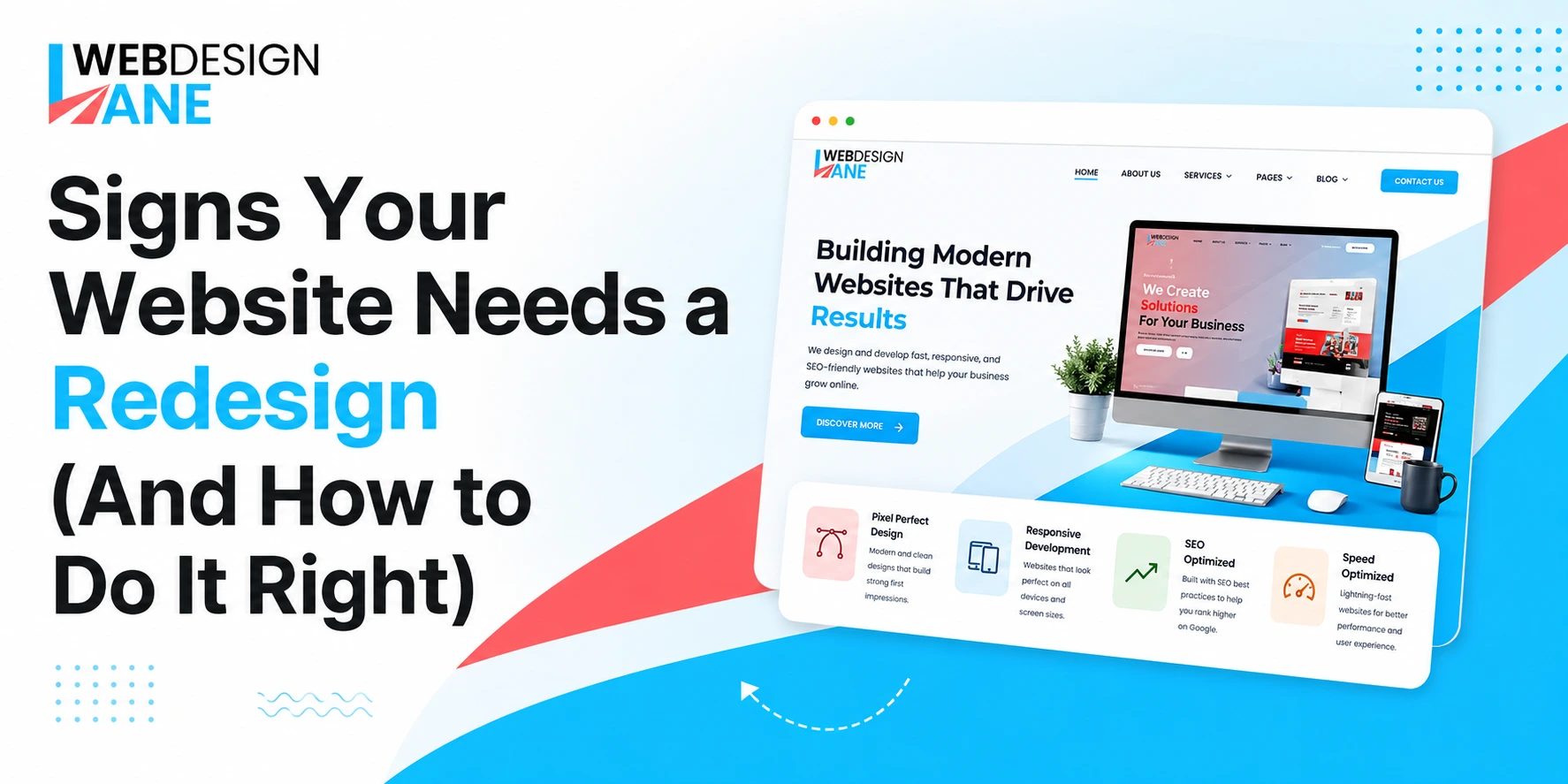

Website redesign services have become essential for businesses that feel their online presence is falling behind. When leads slow down, bounce rates rise, and competitors look sharper, the problem usually goes deeper than a few outdated images or fonts. The root cause is almost always structural, strategic, and technical.
We have worked with businesses across industries that came to us with the same frustration. Their websites looked fine on the surface but were quietly underperforming in every metric that matters. This guide breaks down the exact warning signs to look for, how to determine the right timing, and how to execute a redesign that delivers measurable business growth from day one.
What to Expect from This Website Redesign Guide
By the end of this blog, you will have a clear understanding of:
- The most common outdated website signs businesses overlook until revenue suffers
- How to determine when to redesign a website based on analytics and competitive benchmarks
- A detailed step-by-step framework for planning and executing a redesign
- Platform comparison insights for long-term scalability
- Technical safeguards that protect SEO during migration
- Conversion-focused design principles that turn traffic into action
- The real cost of delaying a redesign
- Answers to five frequently asked questions about website redesign services
Why Every Website Has a Performance Lifespan
A business website is not a static brochure you print once and forget. It is a dynamic growth tool that must evolve alongside branding, consumer behavior, design standards, and search engine algorithms. Industry benchmarks consistently suggest most companies should evaluate website redesign services every two to three years to remain competitive.
Think about how much has changed in just 24 months. Mobile usage patterns shift. Google rolls out major algorithm updates. Competitors launch better experiences. Customer expectations around speed, accessibility, and personalization continue rising. A site built even three years ago may now be silently costing you leads, credibility, and rankings without any visible warning on the surface.
We have seen this firsthand across verticals from healthcare to eCommerce to professional services. What worked beautifully at launch gradually becomes a liability. The companies that treat their website as a living asset rather than a finished product are the ones that consistently outperform their market. Understanding this lifecycle is the first step toward knowing when to redesign a website strategically rather than reactively.
Outdated Website Signs You Should Never Ignore
Many businesses delay action because the site still technically functions. Pages load. Buttons click. Forms submit. But functional is not the same as effective. Recognizing outdated website signs early is the difference between proactive growth and reactive damage control.
Here are the critical red flags we encounter most often during audits.
Bounce Rates Keep Climbing
When visitors land on your website and leave within seconds without clicking, scrolling, or interacting, something fundamental is broken. High bounce rates paired with low conversions almost always indicate that messaging, visual hierarchy, or user experience is misaligned with visitor expectations.
This is not a cosmetic issue. It is a revenue issue. Businesses that invest in a structured landing page design service as part of their redesign consistently see immediate improvements in engagement and lead capture.
Mobile Experience Feels Broken
Most global web traffic now comes from smartphones. If your site forces users to pinch, zoom, scroll sideways, or struggle with overlapping elements, you are actively pushing away the majority of your audience. Mobile responsiveness is no longer a feature. It is a baseline requirement. A poor mobile experience is one of the loudest outdated website signs a business can display in 2026.
Load Speed Is Painfully Slow
Website visitors typically expect pages to load within three seconds. Anything beyond that and they bounce. What many businesses fail to realize is that slow speed also damages search engine rankings.
Google has explicitly made page speed a ranking factor. So a slow site loses visitors and visibility simultaneously. Speed optimization must be a core component of any professional website redesign service engagement.
Your CMS Feels Like a Barrier
If making a simple text change or uploading a new image requires developer intervention, your content management system is working against you. Modern platforms allow marketing teams and business owners to manage content independently. An outdated or overly rigid CMS slows your responsiveness to market opportunities and increases operational costs over time.
Branding Has Evolved, But the Website Has Not
Businesses grow. Services expand. Logos get refreshed. Messaging sharpens. Target audiences shift. When your company has moved forward, but your website still reflects an older identity, visitors experience a jarring disconnect. This misalignment erodes trust and creates confusion about who you are today. It is one of the clearest indicators of when to redesign a website before that gap becomes a competitive disadvantage.
Security Warnings or Compliance Gaps
If your site triggers browser security warnings, lacks SSL certification, or fails to meet current accessibility standards, the impact goes beyond user experience. It affects trust, legal compliance, and search visibility. These technically outdated website signs often remain invisible to business owners until a customer or audit brings them to light.
When to Redesign a Website Based on Real Data
Gut feelings raise concern. Data confirms the decision. Determining when to redesign a website requires objective analysis rather than subjective opinion.
We follow a structured evaluation process with every client before recommending a redesign. Here are the key data points that matter most.
- Traffic trends showing consistent decline over six or more months.
- Conversion rates on key pages are falling below industry averages.
- Session duration dropping, which signals disengagement.
- SEO rankings are slipping for previously strong keywords.
- Competitor benchmarks reveal that rival sites deliver significantly better experiences.
A single dip in one metric may not warrant a full redesign. But when two or more indicators trend downward simultaneously, website redesign services should move to the top of your priority list.
Here is a benchmark comparison table businesses can reference.
|
Metric |
Healthy Range |
Warning Threshold |
|
Bounce Rate |
40 to 55 percent |
Above 65 percent |
|
Page Load Speed |
Under 3 seconds |
Over 4 seconds |
|
Mobile Usability Errors |
Minimal or none |
Frequent layout issues |
|
Conversion Rate |
Industry dependent |
Declining month over month |
|
Organic Traffic |
Stable or growing |
Continuous decline over 6 months |
|
Average Session Duration |
2 minutes or more |
Under 1 minute |
When multiple warning thresholds are crossed, the data confirms what your instincts may already suspect. It is time for a strategic redesign.
We always recommend pulling at least six months of analytics before making the final call. Short-term fluctuations can mislead. But sustained negative trends across multiple data points make the case undeniable. The businesses that understand when to redesign a website based on evidence rather than emotion see the strongest return from the investment.
Strategic Planning Before Any Design Work Begins
Jumping into design without a plan is one of the most common and most expensive mistakes businesses make during a redesign. Website redesign services must begin with clarity around goals, audience, and existing performance data.
Audit Your Current Website Thoroughly
Before touching a single layout or wireframe, you need a detailed picture of what works and what does not.
- Review Google Analytics to identify top-performing pages worth preserving.
- Document pages with the highest exit rates and lowest engagement.
- Gather qualitative feedback from customers and your sales team about website friction points.
- Benchmark your current SEO rankings for critical business keywords.
- Catalog all existing content assets, media, and integrations.
This audit becomes the strategic foundation for every design, content, and development decision that follows. Skipping it leads to guesswork, and guesswork leads to wasted budget.
Define Measurable Goals and KPIs
Every successful redesign starts with concrete objectives. Vague ambitions like “make it look modern” do not create accountability or direction.
Strong examples include:
- Increase lead form submissions by 30 percent within 90 days.
- Reduce homepage bounce rate by 20 percent.
- Improve average session duration by 40 seconds.
- Achieve page one rankings for three new target keywords within six months.
- Increase mobile conversion rate by 25 percent.
When you know exactly what success looks like, every design and technical decision can be measured against that standard. Understanding the right process for building a high-performing website starts with practical steps like hiring the right website designer who aligns with these business objectives.
Designing For Conversions, Not Just Visual Appeal
A beautiful website that does not convert is an expensive piece of digital art. The purpose of a business website is to guide visitors toward specific actions. Every redesign decision should be filtered through one question. Does this help the user take the next step?
Simplify Navigation Ruthlessly
Users should reach any important page within three clicks or fewer. Complex mega menus, buried service pages, and confusing category structures create friction. Friction kills conversions.
Place Clear Calls to Action Above the Fold
Visitors should understand what action you want them to take within seconds of landing on any page. Whether it is booking a consultation, requesting a quote, or starting a purchase, the CTA must be visible, compelling, and unambiguous.
Use Benefit-Driven Messaging
Features tell. Benefits sell. Instead of listing what your product does, explain what it solves. Talk about pain points your ideal customer experiences and position your offering as the solution.
Eliminate Visual Clutter
White space is not wasted space. It is a design tool that directs attention. Crowded pages overwhelm visitors and reduce comprehension. Clean layouts with intentional hierarchy perform consistently better than dense, text-heavy pages.
Structure Content Around User Questions
Your website visitors arrive with specific questions. When your content answers those questions clearly and quickly, trust builds naturally. This approach also supports SEO because search engines increasingly reward content that satisfies user intent directly.
Insights shared in guides about tips to design a high-converting landing page reinforce how structural decisions influence user behavior at every stage of the funnel.
Choosing the Right Platform for Long-Term Scalability
The platform you build on determines how flexible, maintainable, and scalable your new website will be. Making the wrong choice creates technical debt that becomes increasingly expensive to unwind.
For product-driven businesses, investing in robust eCommerce web design services ensures architecture supports inventory management, checkout optimization, payment processing, and future growth.
Here is a platform comparison we frequently share with clients evaluating their options.
|
Platform |
Best For |
Customization |
Ease of Use |
Scalability |
|
WordPress |
Service businesses and content sites |
Very High |
Moderate |
High |
|
Shopify |
Growing product-based brands |
Moderate |
Very Easy |
High |
|
WooCommerce |
Hybrid content and commerce |
High |
Moderate |
High |
|
Magento |
Enterprise-level retail operations |
Very High |
Complex |
Very High |
|
Webflow |
Design forward marketing sites |
High |
Easy |
Moderate |
We always align platform recommendations with the client’s business model, internal team capabilities, content volume, and three to five-year growth trajectory. A platform that fits today but cannot scale tomorrow creates the exact problem that forces another redesign sooner than expected.
Protecting Your SEO Rankings During Migration
One of the biggest fears surrounding website redesign services is losing hard-earned search rankings. This fear is valid because poorly handled migrations can devastate organic traffic overnight. However, when executed properly, a redesign should improve SEO performance rather than damage it.
Here are the critical safeguards we implement with every project:
- Create a complete URL mapping document before launch.
- Implement proper 301 redirects for every changed URL.
- Preserve high authority pages and their internal linking structures.
- Submit updated sitemaps to Google Search Console immediately after launch.
- Monitor indexing and crawl errors daily during the first two weeks.
- Maintain or improve page speed scores across all devices.
- Ensure metadata is optimized for every new and migrated page.
Modern search visibility also requires staying ahead of algorithm shifts and emerging trends. Keeping pace with website design trends shaping SEO ensures redesign decisions remain aligned with what search engines reward today and tomorrow.
When SEO preservation is built into the redesign plan from day one, the transition becomes an upgrade rather than a risk.
The Real Cost of Delaying Your Redesign
Procrastination is the most expensive response to outdated website signs. Every week your underperforming site stays live, it actively works against your business goals.
Consider the compound effect of inaction:
- Potential customers form negative first impressions and choose competitors.
- Search engines favor rival sites with better performance, speed, and UX.
- Your sales team works harder to overcome the credibility gap your website creates.
- Mobile users bounce before they even see your value proposition.
- Lead generation pipelines weaken as conversion paths remain broken.
We have worked with clients who delayed their redesign by a year or more. In nearly every case, the revenue lost during that period of inaction exceeded the total cost of the redesign itself. The math is straightforward. A website that does not convert is a website that actively costs money.
The businesses that act when the data first signals decline rather than waiting for a crisis are the ones that maintain momentum and competitive advantage. Website redesign services are not an expense line. They are a growth investment with measurable returns.
Frequently Asked Questions
Your Website Should Be Working Harder Than Anyone on Your Team
The warning signs are rarely subtle once you know where to look. Website redesign services give you the opportunity to rebuild your digital foundation with purpose, precision, and measurable performance goals.
When the time comes to transform your website from a passive placeholder into a high-performing growth engine, our team at Web Design Lane brings the strategic thinking, technical depth, and conversion expertise that businesses trust to deliver real results. The only question left is how much longer you are willing to let an outdated site hold your business back.